

Soda ash (sodium carbonate, Na₂CO₃) and caustic soda (sodium hydroxide, NaOH) are the two most widely used alkalis in global manufacturing. Many plant buyers and process engineers treat them as interchangeable, but they are not. The core difference lies in alkalinity strength, buffering property, corrosivity, safety and reaction mechanism. There are clear scenarios where soda ash is the better or even mandatory choice over caustic soda.
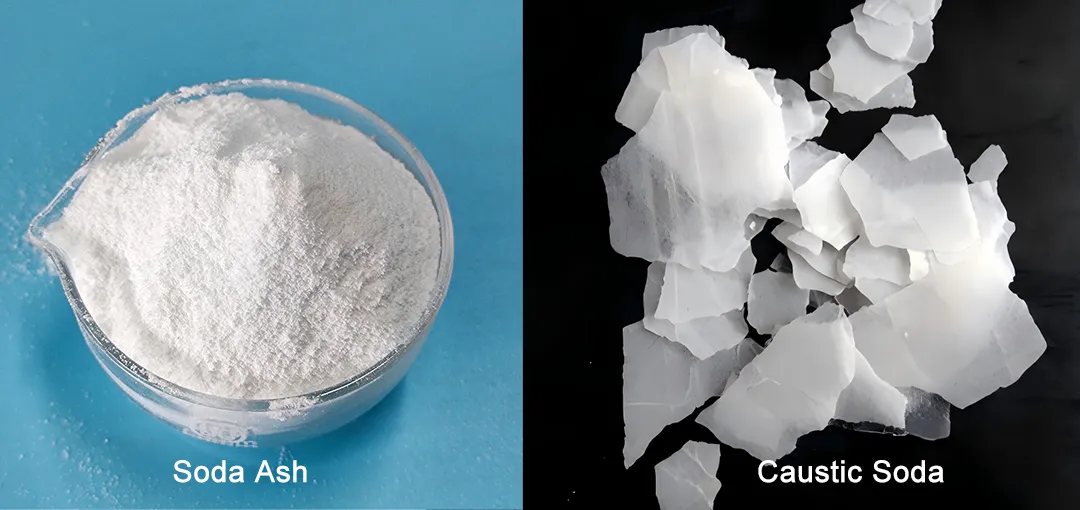
Basic Chemical Difference
Caustic soda is a strong, highly corrosive base. It raises pH rapidly and sharply. Soda ash is a milder alkaline salt with natural buffering capacity. It lifts pH slowly and resists sudden pH spikes, which is the key advantage for many sensitive processes.
1. Glass & Ceramics Production – Soda Ash Cannot Be Replaced by Caustic Soda
Soda ash acts as a fluxing agent for float glass, container glass and ceramic frits. During high-temperature melting, carbonate decomposes and releases CO₂, helping homogenize the melt and remove bubbles. Caustic soda cannot deliver this carbonate function. For glass factories, soda ash is the standard raw material, not an optional substitute.
2. Water Softening & Buffered pH Adjustment in Wastewater
If you need to remove calcium and magnesium hardness from raw water, soda ash is preferred. It precipitates hard minerals into stable carbonate solids. For wastewater treatment that requires stable pH control rather than fast strong neutralization, soda ash’s buffering effect avoids overshooting pH. Caustic soda easily pushes pH far above target and creates re-adjustment troubles.
3. Detergent & Cleaning Formulation
Soda ash serves as a builder in powder detergents, laundry compounds and industrial cleaners. It softens water, improves surfactant performance and stabilizes formula pH. It is milder on fabrics and surfaces, with lower raw material cost than caustic soda for this use case. Caustic soda is reserved for heavy-duty saponification and high-strength degreasing.
4. Processes Requiring Lower Safety & Handling Burden
Caustic soda is highly corrosive, causes severe chemical burns, needs secondary containment, emergency shower facilities and strict PPE management. Liquid caustic also risks freezing in cold weather. Soda ash powder or granules have much lower hazard levels. Storage, silo feeding and transportation are simpler, with less investment in anti-corrosion equipment and safety training.
5. Cost Optimization for Bulk Alkali Consumption
On an alkalinity unit basis, soda ash often delivers better economic performance for large-volume continuous processes. If your process does not require extreme high pH or fast digestion reaction, switching to soda ash can cut long-term chemical and waste treatment costs.
When You Still Need Caustic Soda (Quick Reference)
Choose caustic soda for: pulp digestion, textile mercerization, soap saponification, heavy oil degreasing, fast strong acid neutralization and high-pH chemical synthesis.
Buying Tips for Industrial Buyers
We supply light soda ash and dense soda ash with stable FOB terms. Share your process type, target pH range, dosage requirement and destination country, we can recommend light or dense grade and provide COA, SDS, stable quotation.